

Introduction
Jill Douglas has become a familiar face to sports fans across the United Kingdom, thanks to her impressive career covering rugby, cycling, athletics, and some of the world’s biggest sporting events. Known for her confident presenting style, sharp journalistic instincts, and deep understanding of rugby union, she has built a reputation as one of British sports broadcasting’s respected figures. Yet beyond the cameras and touchline interviews, many people are curious about another part of her life: who is Jill Douglas husband?
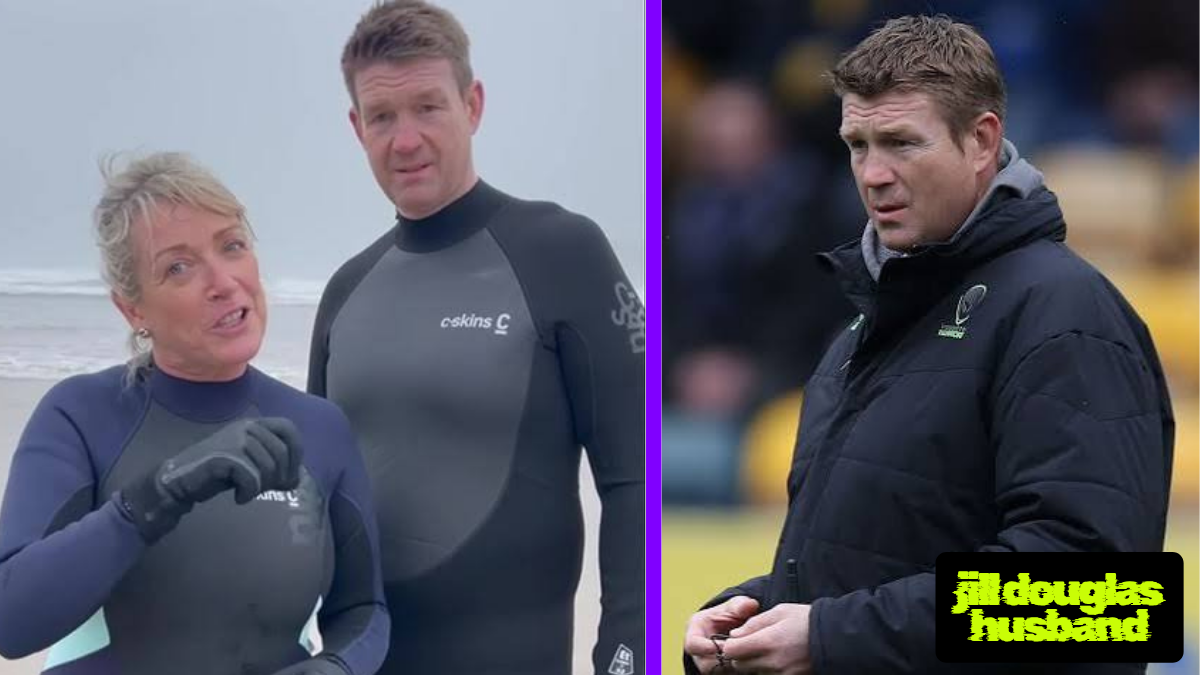
The answer is Carl Hogg, a former Scotland international rugby player who went on to build a career in rugby coaching and player development. The couple share a connection to the sport that has shaped much of their professional lives, although they have pursued different roles within it. While Douglas reports on matches and interviews players, Hogg has worked behind the scenes to coach athletes and help develop rugby talent.
Their relationship is particularly interesting because rugby is more than simply a shared professional interest. It is part of the wider sporting environment in which both have spent much of their working lives. Together, they have raised two children and established a family life in Cheltenham, England, while continuing to maintain their connections to the game.
In this article, we explore Jill Douglas’s husband, Carl Hogg, his rugby career, their family life, and the broadcaster’s own professional achievements. We will also look at how their shared passion for sport connects two different careers in the rugby world.
Who Is Jill Douglas’s Husband?
Jill Douglas’s husband is Carl Hogg, a former Scottish international rugby union player who later became a rugby coach. Unlike his wife, whose work places her in front of television cameras, Hogg has primarily built his career through playing, coaching, and developing rugby players.
Hogg represented Scotland at international level during his playing career. His experience as a professional rugby player helped provide a foundation for his later work in coaching, where understanding the demands of the game is essential. Moving from playing to coaching is a familiar path in rugby, allowing former players to pass on their knowledge to the next generation.
The couple’s professional backgrounds make them an interesting sporting partnership. Douglas has spent decades explaining matches and telling the stories behind major sporting occasions, while Hogg has worked directly with players and teams. Although their jobs are different, both careers require preparation, teamwork, and a detailed understanding of rugby.
What Does Carl Hogg Do?
Carl Hogg is known for his work in rugby coaching and player development. After his playing career, he moved into coaching roles that involved helping athletes improve their skills, understand tactical systems, and prepare for the demands of competitive rugby.
A coach’s responsibilities extend far beyond selecting a team on match day. Coaches work on training plans, player development, fitness, tactical awareness, and the culture of a squad. They also help players navigate the pressures of professional sport, where performance, injuries, and competition for positions can affect careers.
Hogg’s career has included work in English rugby. Rugby World reported that he was involved with Gloucester Rugby as Director of Academy and Development, a role focused on developing players and supporting the club’s pathway for emerging talent. His professional work reflects the importance of coaching and long-term development within modern rugby.
Why Is There Interest in Jill Douglas’s Husband?
Part of the public interest comes from Douglas’s visibility as a broadcaster. Sports presenters often become familiar personalities to viewers who follow major tournaments, particularly when they appear regularly throughout a competition or interview well-known athletes.
Douglas’s rugby expertise also means that viewers may naturally wonder about her life away from the television studio. When a broadcaster is married to someone who has played and coached the same sport, the connection adds another layer of interest to their biography.
However, the couple have not made their private relationship the centre of their public identities. Most reliable coverage focuses on their professional lives and the broad facts of their family circumstances. That makes it important to distinguish confirmed details from assumptions about how their marriage works behind the scenes.
Jill Douglas and Carl Hogg’s Marriage
Jill Douglas and Carl Hogg are married and have built a family life alongside their involvement in rugby. Their relationship brings together two people who understand the pressures of working in sport, although their professional responsibilities differ considerably.
Douglas’s work often requires travel, preparation for live broadcasts, and reporting from major competitions. Coaching, meanwhile, can involve demanding training schedules, match-day responsibilities, and the ongoing development of players. Both professions require commitment and flexibility, particularly during busy periods of the sporting calendar.
Despite the demands of their careers, the couple have raised two children together. Edinburgh Napier University, Douglas’s former university, reported in October 2024 that she lives in Cheltenham with her husband Carl and their children. The institution’s profile also highlights her extensive career in broadcasting and charity work.
A Relationship Built Around a Shared Sporting World
Rugby has played an important role in both Douglas’s and Hogg’s professional lives. For Douglas, the sport became a major part of her career after she moved from general journalism into sports broadcasting. For Hogg, rugby developed from a playing career into coaching and player development.
This shared background may give the couple a common understanding of the sporting world, including the commitment required to work at a high level. However, without detailed public statements from them about their private relationship, it would be inappropriate to make assumptions about how their shared professional interests influence their marriage.
Their careers also illustrate two different ways of contributing to the same sport. Broadcasters help audiences understand the action and the personalities involved, while coaches work directly with players to improve performance and develop teams.
Keeping Their Private Life Away From the Spotlight
Although Douglas has spent much of her career in front of the public, she has generally kept her family life relatively private. Her professional interviews and public biographies tend to concentrate on her broadcasting achievements, sporting interests, and charitable activities rather than the personal details of her marriage.
This approach is not unusual among people working in high-profile professions. A public career does not necessarily mean that every family occasion or personal experience must become part of a public narrative.
As a result, reliable information about Douglas and Hogg’s relationship is centred on established facts: they are married, have two children, and live in Cheltenham. Claims about private disagreements, romantic milestones, or the details of their relationship should not be presented as facts without credible supporting evidence.
Who Is Jill Douglas? Her Journey From Journalism to Sports Broadcasting
Although the keyword “Jill Douglas husband” focuses on her marriage, Douglas’s own career deserves equal attention. She is a Scottish sports broadcaster and journalist whose work has covered rugby union, cycling, athletics, and major international competitions.
Originally from the Scottish Borders, Douglas began her career in print journalism. She worked for The Southern Reporter before moving into television journalism, where she covered local news and sport. Her early experience gave her a foundation in reporting, researching stories, and interviewing people across a range of subjects.
Her transition into sports broadcasting eventually brought her to national television. Over the years, she became associated with major rugby competitions and international sporting events, earning recognition for her ability to explain the action while keeping viewers connected to the people behind the results.
Her Early Career in the Scottish Borders
Douglas grew up in Bonchester Bridge in the Scottish Borders, an area with a strong rugby tradition. She attended Jedburgh Grammar School and later studied journalism at what is now Edinburgh Napier University.
In a university profile published in 2024, Douglas recalled that her interest in journalism began when she was young. She sought work experience at her local newspaper and eventually developed a career that took her from local reporting into national sports broadcasting.
Her early experience at The Southern Reporter helped her learn the practical skills of journalism. Reporting involves more than asking questions: it requires checking information, understanding the subject, identifying important details, and communicating clearly to an audience. Those skills became valuable as her career moved into live sport.
Becoming a Pioneer in Rugby Broadcasting
One of Douglas’s significant career milestones came in 1997, when she became the first woman to present the BBC’s Rugby Special programme. At the time, rugby broadcasting was a field in which women were far less visible in leading presenting roles.
Her appointment represented an important step in her career and helped establish her as a knowledgeable voice in rugby coverage. Rather than limiting herself to general sports reporting, Douglas developed expertise in a sport with a complex set of rules, tactics, and traditions.
Her progress also reflected the value of subject knowledge. Rugby audiences expect presenters to understand what is happening on the pitch, explain key decisions, and ask informed questions of players and coaches. Douglas’s experience as a journalist and her longstanding interest in rugby helped her build credibility in this demanding environment.
Jill Douglas’s Work With the BBC, ITV, and Sky Sports
Douglas’s broadcasting career has included work for several major British media organisations. She joined Sky Sports in 1999, where she presented sports news and covered rugby and athletics. In 2003, she returned to the BBC to work across its national sports coverage.
Her career has extended beyond rugby union. She has covered cycling, athletics, snooker, and other sporting events, demonstrating the versatility required of a broadcaster working across different disciplines. Each sport presents its own challenges, from understanding the technical details of a competition to explaining the significance of a result to viewers who may be new to it.
Douglas has also worked on major international events, including Olympic Games, Commonwealth Games, Rugby World Cups, Six Nations Championships, and British and Irish Lions tours. These assignments have taken her to some of the most important occasions in the sporting calendar.
Covering Major Sporting Events
Presenting or reporting at a major tournament requires detailed preparation. Broadcasters must understand the competitors, recent results, team selections, and wider stories that may shape a match or event. They also need to adapt quickly when unexpected developments occur.
Douglas’s experience across multiple sports has given her opportunities to work in different broadcasting environments. Rugby requires a strong grasp of tactics and team dynamics, while cycling coverage often involves explaining race strategy, course conditions, and changes in the standings. Major athletics competitions demand a similar ability to communicate technical information clearly.
Her work across these disciplines demonstrates that sports journalism is not simply about being present at an event. It involves research, storytelling, and the ability to make complicated or fast-moving action understandable to a broad audience.
Her Continued Connection With Rugby
Rugby remains a defining part of Douglas’s professional identity. She has presented coverage of major international competitions and worked alongside commentators, analysts, former players, and coaches to help audiences understand the game.
Her background in the Scottish Borders has also contributed to her long-standing interest in rugby. She is a supporter of Hawick Rugby Club, a connection that reflects her ties to the community in which she grew up.
That local connection sits alongside a career that has taken her to major international venues. It is a reminder that a broadcaster can maintain a strong attachment to grassroots sport while working at the highest levels of professional coverage.
Carl Hogg’s Rugby Career and Coaching Work
Carl Hogg’s career provides another perspective on the sport that connects him with Jill Douglas. His experience as a former Scotland international gave him first-hand knowledge of elite rugby before he moved into coaching and development roles.
Playing international rugby requires technical ability, physical preparation, tactical awareness, and the ability to perform under pressure. Former international players often draw on those experiences when they become coaches, although successful coaching also demands communication skills, organisation, and the ability to help individuals develop.
Hogg’s later work has involved supporting rugby players and helping develop talent. These responsibilities are particularly important in professional clubs, where young players must be prepared for the transition from academy rugby to senior competition.
From International Player to Coach
The transition from playing to coaching can be a major career change. A player concentrates on performing within a team, while a coach must consider the performance of the whole squad, the needs of individual athletes, and the tactical demands of upcoming matches.
Former players may bring practical knowledge of the game, but they must also learn how to teach and communicate effectively. Coaching requires explaining concepts clearly, identifying areas for improvement, and adapting training methods to suit different players.
Hogg’s progression into coaching reflects this broader pathway within rugby. His professional identity is now associated with developing players and supporting teams rather than simply his own achievements on the field.
His Connection With Gloucester Rugby
Rugby World reported that Hogg held a role as Director of Academy and Development at Gloucester Rugby after joining the club in 2021. Academy and development roles help clubs build pathways for younger players, with the aim of preparing promising athletes for the demands of senior rugby.
Player development involves much more than technical training. Young athletes must learn how to manage competition, maintain fitness, understand team systems, and handle the pressure of pursuing professional careers. Clubs therefore rely on coaches and development staff to provide structured support as players progress.
Hogg’s work in this area highlights the contribution that happens beyond the televised match. While audiences often focus on the players who score tries or win international honours, a club’s development system can play an important role in building its future squads.
Jill Douglas and Carl Hogg’s Children and Family Life
Jill Douglas and Carl Hogg have two children. Edinburgh Napier University and Sported have both reported that Douglas lives with her husband and their children in Cheltenham.
The couple have not made their children’s private lives a central feature of their public profiles. This means that much of the available information about the family is limited to broad biographical details rather than a running account of their children’s activities.
That privacy is worth respecting. Children of people in public-facing professions may attract curiosity, but their parents’ careers do not automatically make their personal experiences public information. A factual profile can acknowledge the family without speculating about individual personalities, schooling, or future ambitions.
Raising a Family While Working in Sport
Sports broadcasting and professional coaching can involve demanding schedules. Presenters may travel to tournaments, prepare for live coverage, and work evenings or weekends. Coaches often have similar commitments around training sessions, matches, player meetings, and development programmes.
Balancing those responsibilities with family life requires organisation and flexibility, although the precise arrangements within Douglas and Hogg’s household have not been publicly detailed. It is therefore best not to assume how they divide their responsibilities or manage their schedules.
What is publicly established is that they have built their family life in Cheltenham while maintaining their involvement in rugby. This provides a useful outline of their circumstances without turning private matters into speculation.
Life in Cheltenham
Cheltenham is the family’s reported home base, according to Edinburgh Napier University and Sported. The town is in Gloucestershire, England, and provides a connection to the wider English rugby community.
For a family involved in professional sport, living near clubs and sporting facilities can be a practical consideration. However, there is no need to assume that any particular property, neighbourhood, or lifestyle arrangement explains the family’s choice of home.
The publicly reported information is straightforward: Douglas and Hogg live in Cheltenham with their two children. Beyond that, the family’s day-to-day routines remain largely private.
Jill Douglas’s Charity Work and Recognition
Douglas’s influence extends beyond sports broadcasting. She has also been closely involved with charitable work, particularly through the My Name’5 Doddie Foundation, which supports research into motor neuron disease, also known as MND.
The foundation was established in honour of former Scotland rugby international Doddie Weir, who publicly discussed his diagnosis and helped raise awareness of the disease. Douglas was a close friend of Weir and played an important role in the foundation’s development, serving as its chief executive for six years.
Her work in this area reflects the broader role that sports figures and journalists can play in charitable initiatives. Their connections with athletes, clubs, audiences, and the media can help bring attention to causes that might otherwise receive less public visibility.
Her Work With the My Name’5 Doddie Foundation
Douglas became involved with the foundation from its early days and served as chief executive until spring 2024. According to Edinburgh Napier University, she helped establish it as a major MND research charity and supported fundraising and awareness efforts.
The foundation’s work is connected to the wider effort to improve understanding of MND and support research into the condition. Charities in this area can help fund scientific projects, connect supporters with researchers, and raise public awareness of the challenges faced by people living with the disease.
Douglas’s involvement demonstrated a different side of her professional life. Rather than reporting on sporting achievements, she was helping lead an organisation with a charitable mission and a focus on long-term impact.
Receiving an MBE and Other Honours
Douglas was appointed a Member of the Order of the British Empire (MBE) in the 2022 New Year Honours for services to sport and charity. The recognition acknowledged contributions extending beyond her work as a presenter.
In October 2024, she returned to Edinburgh Napier University to receive an honorary doctorate. The university highlighted both her broadcasting career and her charitable work, recognising the achievements of a former student who had gone on to become a prominent sports journalist.
These honours add context to her public profile. Douglas is known not only for appearing on television but also for her contribution to sports journalism, her work across major international events, and her involvement in charitable initiatives.
What Makes Jill Douglas and Carl Hogg’s Story Interesting?
The story of Jill Douglas and her husband Carl Hogg is notable because their careers connect them to different sides of the same sporting world. Douglas has spent years helping audiences understand rugby and other major sports, while Hogg’s work has centred on playing, coaching, and player development.
Their professional experiences offer a reminder that sport depends on many people beyond the athletes who compete. Journalists and broadcasters help communicate the drama and significance of events, while coaches and development staff help players prepare, improve, and progress.
Their marriage is one part of a wider story involving two careers, a shared interest in rugby, and family life away from public attention. Although details of their relationship remain private, the information that is available presents a clear picture of their professional backgrounds and family circumstances.
Conclusion
Jill Douglas’s husband is Carl Hogg, a former Scotland international rugby player who later built a career in coaching and player development. Together, they have two children and live in Cheltenham, maintaining their connection to the sporting world while keeping much of their private life out of the spotlight.
Douglas has established her own impressive legacy as a sports broadcaster, covering rugby, cycling, and major international competitions. Her pioneering role on the BBC’s Rugby Special, her work across leading broadcasters, and her charitable contribution through the My Name’5 Doddie Foundation have made her a respected figure in British sport.
For readers searching for “Jill Douglas husband,” the answer is Carl Hogg. But their story is about more than a marriage: it brings together broadcasting, rugby, family, and a shared connection to the sporting community.
You May Also Read:Ari Dayan Husband: Who Is Brett Gelman? Inside Their Marriage, Wedding, and Creative Partnership
For more visit usaradar.co.uk

10 Comments
Pingback: Maggie Alphonsi: The Inspiring Journey of England’s Rugby Legend, Broadcaster, and Trailblazer - Usa Radar
Pingback: Dani Fennessy: Inspiring Career, Personal Journey, and the Story Behind New Zealand’s Media Personality - Usa Radar
Pingback: Stacey Waaka: Inside the Inspiring Career, Rugby Success, and Personal Story of New Zealand’s Sporting Star - Usa Radar
Pingback: Portia Woodman: Inside the Remarkable Rugby Career, Olympic Glory, and Inspiring Journey of New Zealand’s Sporting Icon - Usa Radar
Pingback: Keith Jackson: The Legendary Voice of College Football and the Remarkable Story Behind His Broadcasting Career - Usa Radar
Pingback: Brent Musburger: The Legendary Sports Broadcaster’s Life, Career, and Lasting Legacy - Usa Radar
Pingback: Katherine Webb: Her Rise to Fame, Modeling Career, Family Life, and Life Beyond the Spotlight - Usa Radar
Pingback: Elizabeth Rose Cameron: Inside the Private Life, Family Background, and Story of James Cameron’s Daughter - Usa Radar
Pingback: Claire Cameron: Inside the Life, Books, and Remarkable Career of the Canadian Author - Usa Radar
Pingback: Jasper Robards: Inside the Family Background and Private Life of Sam Robards' Son - Usa Radar